
Manaslu 2012
Written by Leader Chris Groves, October 2012
Even in a busy airport terminal on a Saturday afternoon it was easy to spot Jerry then Kevin, bulging kit bags give the game away every time. Check-in was easy although Jerry did need to do a bit of repacking and negotiate his excess baggage charges. James was making his own way and would meet us in Kathmandu. With no problems with the flights or stopover in Delhi, we were soon in the queue for visas on arrival in Nepal. This step was also easily passed, bags collected then out of the airport to be met by the ever present Kwal, into a minibus then off to the Summit Hotel. James, similarly had no problems and arrived a couple of hours later. With the team complete we had a welcome puja ceremony followed by beer, a chat and a meal at the hotel.
After a kit check and a quick shopping trip into Thamel, there was plenty of time to relax during the first full day in country. The majority of equipment and local staff had departed the previous day and were en route to basecamp. Thankfully they had reported back about the road conditions so, we went on an amended route the next day. Just fitting into a large 4WD with our Sirdar, Pasang and cook Dawa squashed in the back, and with all bags on the roof, we left Kathmandu at 0730 on the journey to Arughat. Covering a variety of road surfaces, the 4WD came in handy on several occasions, especially as we negotiated many landslides. We travelled through interesting terrain from steep hillsides to cultivated farm land, arriving at our destination, literally the end of the road, late afternoon.
We would approach the mountain via the Manaslu trek, initially heading north following the Buri Ghandaki River upstream. Our starting altitude was only 600m, it was very hot and humid the first few days as we walked on wide tracks through rice fields and past banana trees not gaining much height. Opportunities to stop were limited, generally we walked for a couple of hours, had a long lunch break then continued for a couple more hours until we arrived at a tea house, our overnight stop. On the second day of the trek we left the cultivated land behind as the river gorge and path narrowed. In fact the path was now cut into the rock as we climbed up above the river. We continued ascending and descending several times, crossing many tributaries often on high suspension bridges. Lunch stops were a chance to cool down and wash out shirts that were soaked in sweat.
The trek was spectacular, as the area becomes more popular there is a great amount of construction going on. Excellent tea houses are being built all along the route. The gorge is very impressive with a number of waterfalls and cascades several hundred feet high. One lunch stop was a Tato Panni £ some hot water springs. We saw monkeys, lots of butterflies and forests of cannabis plants. Sometimes we were right next to the raging river, other times we were way above it, crossing it many times. The trail was very quiet, occasionally we'd meet descending pack horses, everyone knew to stand on the inside of the trail rather than be pushed off over the side.
The afternoon of the 4th day was probably the hardest, at least the longest. A 4-hour trek to Deng, thankfully, mainly in the shade as we were deep in the gorge but we crossed the river several times climbing high and descending low every time. The following day we climbed steeply up through woodland, thankfully temperatures and humidity had dropped so everything was more comfortable, plus we were beating guidebook times. Days 6 and 7 were only really half days as the altitude gains became considerable. The valley started to open out as we left the narrow gorge below and behind us. One afternoon we visited a monastery high above the village of Lho. Now we walked past fields of barley and maize. After 7 great days we arrived at Samagaon, the village at the base of the mountain, but we still hadn't seen Manaslu. We also met Thundu, one of our sherpas £ Tsering our final sherpa was setting up base camp with Pasang 2, the cook's assistant.
After a couple of days of acclimatisation walks we made the steady climb up to base camp, 4,850m in 4£ hours, 14 days after leaving the UK. We were in the cloud and it started raining. Unbelievably, the first rain of the trip. Base camp was busy, I heard there were 22 permits and nearly 300 people up there but our camp was higher than most, slightly hidden and it really didn't feel too busy.
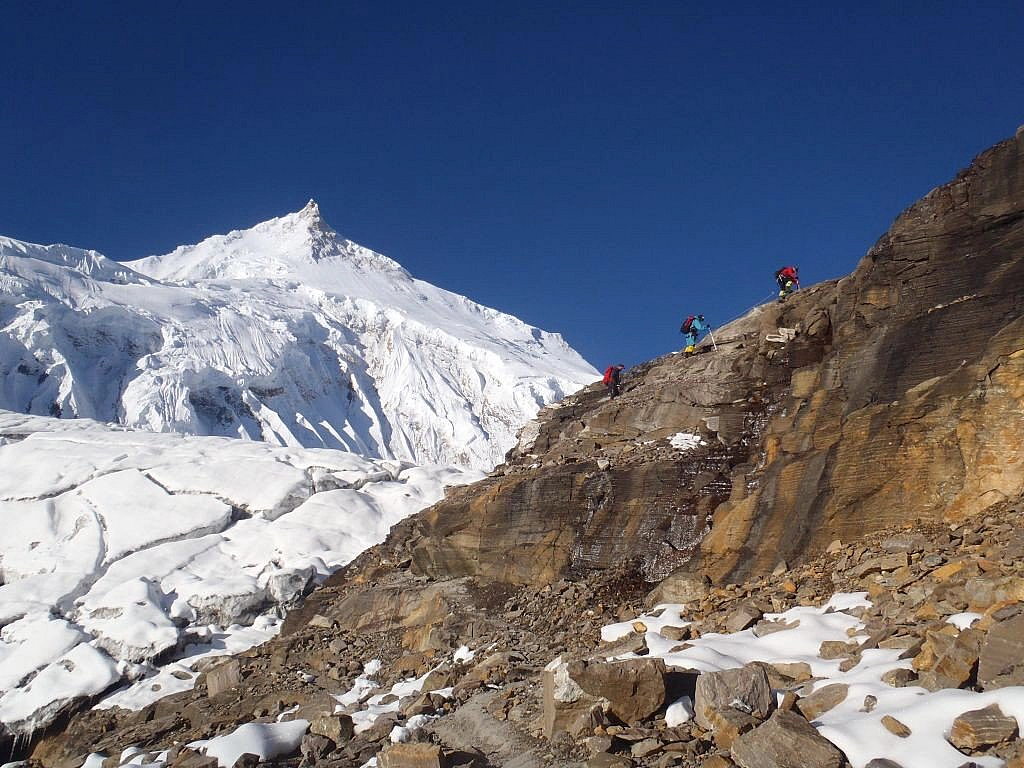
The first couple of days were spent sorting equipment and food, generally preparing to go higher. We had a trip up on to the glacier, 5,150m, practised the safe use of fixed ropes and were very well fed by Dawa. My umbrella, unused on the trek, came in very useful as most of the initial days were wet. We sheltered under a tarp for our puja (blessing ceremony) but the skies briefly cleared and we had a view of the top £ a good sign. The next day was clear and the views were stunning £ I had a view of the top as soon as I unzipped my tent. I got the shower working and it was well tested by all. Thundu and Tsering went up and set up camp 1, ready for us to take up residence the next day.
It was quite a long hot day, with fierce sunshine on the glacier as the team headed up on the mountain proper. The terrain was stunning and after 5£ hours, with a sting in the tail (the steepest bit was the last climb) we arrived in C1, 5,650m. Not a solitary experience £ I counted c70 tents, but it didn't matter, it felt great and you couldn't help but just stare at the views and route upwards. The following morning we went a little higher, to the start of a traverse on fixed ropes before going back down to BC. With most teams arriving ahead of us on the mountain things were busy with people going up to C2. The weather was good and after a rest day we planned to head up to C1 then C2 ourselves, with continued good weather we could be on top in a weeks time.
Waking the following morning I could hear the team leader next to us on the radio, something was obviously wrong. There had been a huge avalanche high on the mountain that had affected camps 2 and 3. Not only were there casualties, there had be several fatalities. Things, plans, changed very quickly. Thankfully all our team and staff were safely in BC. Events unfolded, there was much confusion as to the numbers involved. Helicopters helped with rescues and searches. A very strange day, we were there, but not really part of it. There were emails and calls home to reassure family and friends that we were OK. More searches the next day, Pasang flew up to the scene to help, on his return he said he wasn't going out of BC again and he wouldn't send Sherpas up either; the risks were just too great.
After a couple of very sombre days, the team got away early and headed up to C1, with a view to go to C2 just for a look. There had been a near miss with ice falling on Sherpas going up to C2, we heard and saw a number of avalanches on our way up. In a reduced Camp 1 we had a very clear view of the dangers above. It was obvious, Pasang was right, the risks were too great. We were not going any higher.
Amazingly quickly BC was dismantled, we descended to Samagaon and had a spectacular 30-minute helicopter flight back to the noise and chaos of Kathmandu.
Itineraries are never fixed, the trek in was very very good and set us up well for the climbing above. Initial preparations meant everything and everyone was well placed to attempt the summit, then everything changed. The risks were just too high to continue and sadly we finished early. But it won't stop any of us returning to the mountains. Huge thanks must go to our Nepalese team, lead by Pasang, who were outstanding in everything they did. These expeditions would be so much harder, uncomfortable, less enjoyable and pretty much impossible without them.
Chris Groves
Manaslu expedition leader
Kathmandu, 30 September 2012
Categories
- Announcements (0)
- Blogs (0)
- News (0)
- Trip Reports (0)
- Articles (0)
Archives
- May 2026
- April 2026
- March 2026
- February 2026
- January 2026
- December 2025
- November 2025
- October 2025
- September 2025
- August 2025
- July 2025
- June 2025


